Sunday, September 5, 2021

Robots in a tent

In Lower Austria there is children's festival each year in Herzogenburg. COVID checks were required to enter, so masks required.   Robotix4Me has booth each year, which is a tent. A walking Lego robot nicknamed Robbie, is demo'd at the tent entrance. Here ~15 Lego Mindstorms kits are set out for kids to try to build, modify, and program a robot to move and sense something. The tables are usually full of children. Younger ones get to try out BeeBots or new Lego Spike with Scratch or Icon language (similar to Scratch Jr). Photos were taken during lunchtime when we had less of a crowd.

Personally I was amazed how good a robot the children could create in such a short time. A 6 year old did the best programming of those I helped. She used an existing Lego Spark robot using a version of Scratch to try out different ways to control motors moving wheels and a "fan" by reacting to various sensors. 

Brothers working together

Robots are more interesting than lunch

Saturday, April 20, 2019

FIRST, the big robots

 I volunteered to help at the FIRST Championships in 2019 and was assigned to the high school age FIRST large robots. The variety and how simple robots from poorer countries kept up with the fancy all wires in row via clips richer countries.  Strategy was to do as much of challenges as possible and in necessary hinder your opponent for doing challenges.   Better teams had roles assigned, but rotated some so all got to be active on the field during some challenge. Two teams competed against two other teams. Here is a video of part of a match.


Tuesday, July 24, 2018

Robotix4Me in Lower Austria

After reconnecting with a St.Pölten teacher at Modelbau in March 2017 I started helping and learning with Robotix4Me (many photos) in area of Lower Austria I live in. 

Brief Overview:

Robotix4Me offers
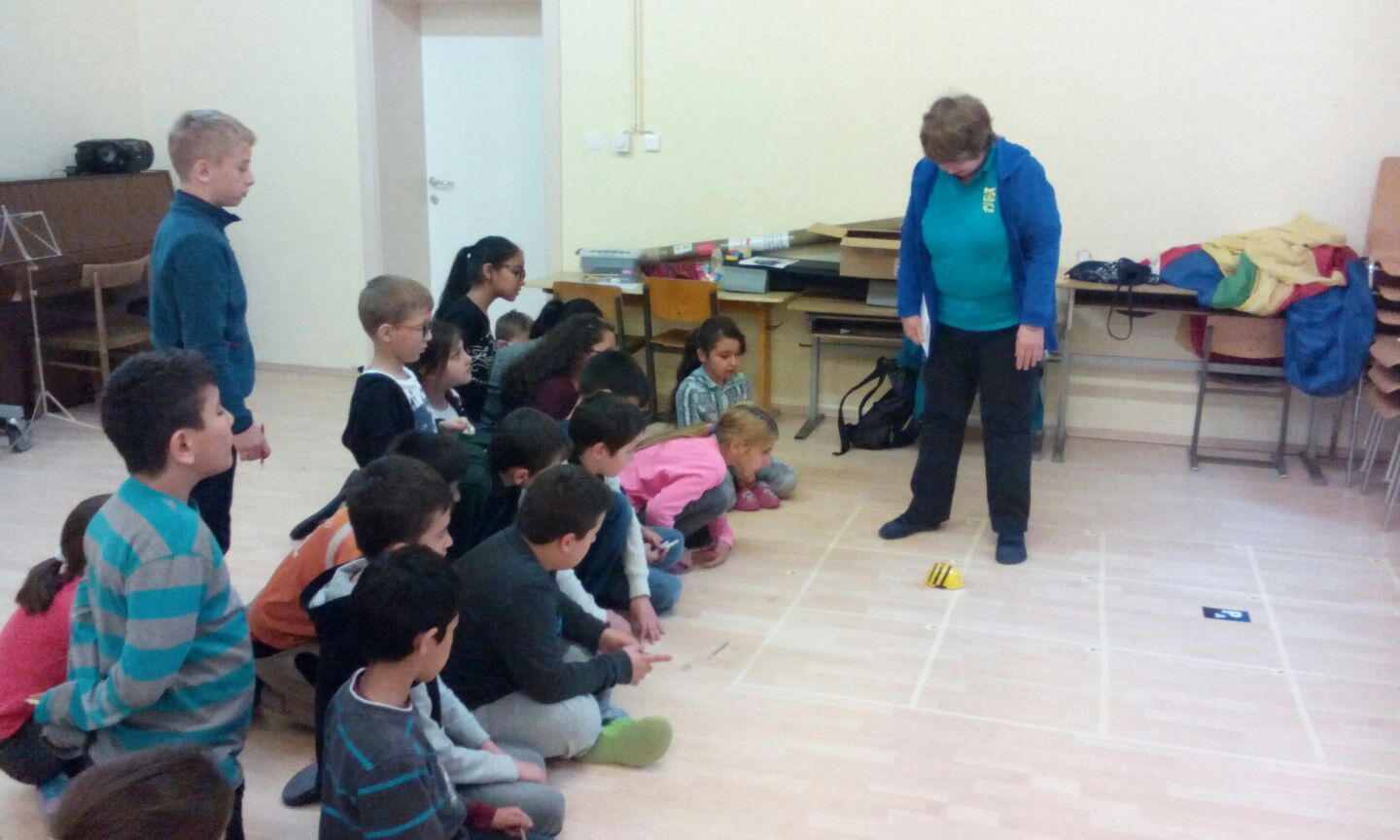
  1. Begin with BeeBots, fun problem solving 
  2. In middle programming robots to feel and move 
  3. Every day use Industry 4.0 IOT=Internet Of Things 
    • via traffic light with various hardware

  • My Poster presentation at First Lego League contest
  • Helping with BeeBots in schools,
  • Helping with and learning about First Lego League 
    • One of coaches for Lillenfeld 
  • Raspberry Pi Intro lessons
  • Lego EV3 programming training 
  • Encouraging use of Raspberry Pi. 
  • Modelbau in St.Pölten in 2018
  • Where connected in2017
  • Learned about other robots like Thymio
  • Visited RoboCup Junior 
    • Current project: Use of EV3DEV for soccer ball completion.
  • Attended RedNode overview

See Robotix4Me website for pictures. Images may be posted here later.

.[Note: My hair varies alot in photos, but praise the Lord I am cancer free. ]


Monday, April 24, 2017

Wann kommst du wieder?= When will you come again?

BeeBot in Daniel Gran II Schule April 5


  • 21 3rd graders
  • 3 stations (6 or 8 groups)
    •  Play robot one child programmed the other
    • BeeBot math 
      •  add 2 numbers like 3+5
        • 3 forward, pause, 5 forward, pause (on 8)
      • 2 digit numbers like 25
        • go to 2, pause, got to 5
    • BeeBot in traffic
  • end  class challenge
    • show path to number
    • showBeeBot buttons pressed to number
    • best 4 received a chocolate Easter lamb


Monday, May 18, 2015

Phyto-BioActive Food Pyramid app

Finally have prototype following article in William Carey Journal Fall 2014 (Oct) PHYTO-BIOACTIVE FOOD PYRAMID ©: A HEALTHY DIETARY PLAN FOR PREVENTING CERTAIN COMMON CANCERS  (references in comments)
and a Poster presentation at Texas A&M in Feb. 2014

Here is the current prototype.  In May of 2015 request go forward to demo and release an Android version in Play was requested. 


Thursday, July 25, 2013

July 2013 30 Minutes Robotics

What can you do in a 30 minute Robotics workshop with 6 children (ages 6-12)?
2 days x 4 workshops
Week's Theme: Space
2 Stations - 2 robots

Station 1: Space Travel: 
BeeBot on Solar System puzzle

Plan your path to the moon, planet, asteroids or star.

(First group put puzzle together and last one took apart)

Took turns in circle. When 2 workers broke group in half.
Task 1: Can you go from sun to a planet or moon? (usually just straight)
Task 2: Can you go to 2 places? (turn)

[some went back after NXT and light sensor]
Task 3: Go is a square [just to see if they could]
Task 4: Go in a circle when arrive at location


Station 2: "Solar" robot:
Lego NXT with Light Sensor using Mindstorms

1) What is a Light Sensor?
Demo the light sensor program that shows light readings.
Children read values:
a) room light 40-60 
b) dark (finger over sensor) 2-18
c) Handi flashlight 80-100

1b) Better having light sensor point forward or up?
Except first day all chose the sensor pointing up as best.
Some groups tried both before deciding.


2) Follow the light

If bright light, then drives forward. (like wisemen followed Christmas star)

Children took turns trying it out.


3) What should the robot do if no light?
[Motor ports]
Ideas the 8 groups tried:
* Come back to me
* Turn in a circle until see light again
  [but hard to direct out of the circle to somewhere]
* Turn slightly [Easier to direct]

Turn direction: What if reversed ports motors plugged into?


Additional station idea: 
Build a 5 minute Bot with parts pre-sorted.
Children would have liked to build a robot, but was alone first day.
Worked 2 years ago having 2-3 children work together to build a robot in 5-10 minutes.

Friday, July 19, 2013

July 2013 Dancing Robots

TechNike: Bühne frei: Roboter-Tanz [Stage free: Robot Dancing]

Length: 3 days
Program: Enchanting
Front-end: Scratch Puzzle Piece language
Back-end: Lejos (Java) on NXT
Emphasis on symmetry 

With Enchanting did more, faster like with Scratch.  This also meant restructuring lessons plans to include more fast.  


Of course in Austria the robots waltzed.

Featured on the TU Wien Informatik lab website.

Dances

  • Designed dance steps(alone): Create own block
  • Programmed familiar dances (together) like waltz and mirror partner robot
  • Class choreography dance:  Can we do the same thing at same time?
  • Repeated sequences of steps using very basics and reacting to sensors;
  • Basic symmetric movements: forward/backward; left/right
  • Basic forms: line, square, circle (turn in place, in big circle)
Sensors used: 
  • as signals to start or stop
  • to avoid a wall or robot, 
  • to advance to partner
  • to follow light and lines as guides.
Display and Sound
  • Screen animation to match movements
    • Could draw their own
  • Music notes as moved
  • Beginning and end sounds
Drawing Robot movements: enjoyed exploring
[could come earlier to teach design]
  • Figures
    • example was a star
    • A team tried to draw a heart, points were a probl
  • Draw Dance steps
    • A team used robot like spiral graph turning circles with slight changes each time